
Doula supporting pregnant client and partner on yoga ball
The word doula comes from ancient Greek, meaning “one who serves.”
A doula is an experienced support person who provides dynamic and informed support during pregnancy, labor, and postpartum.
While birth can be powerful and transformative, it can also feel overwhelming or uncertain. Whether this is your first baby or your 10th - whether you’re planning a home birth, hospital birth, medicated or unmedicated - having steady, continuous support can make a meaningful difference.
What does a doula do during labor?
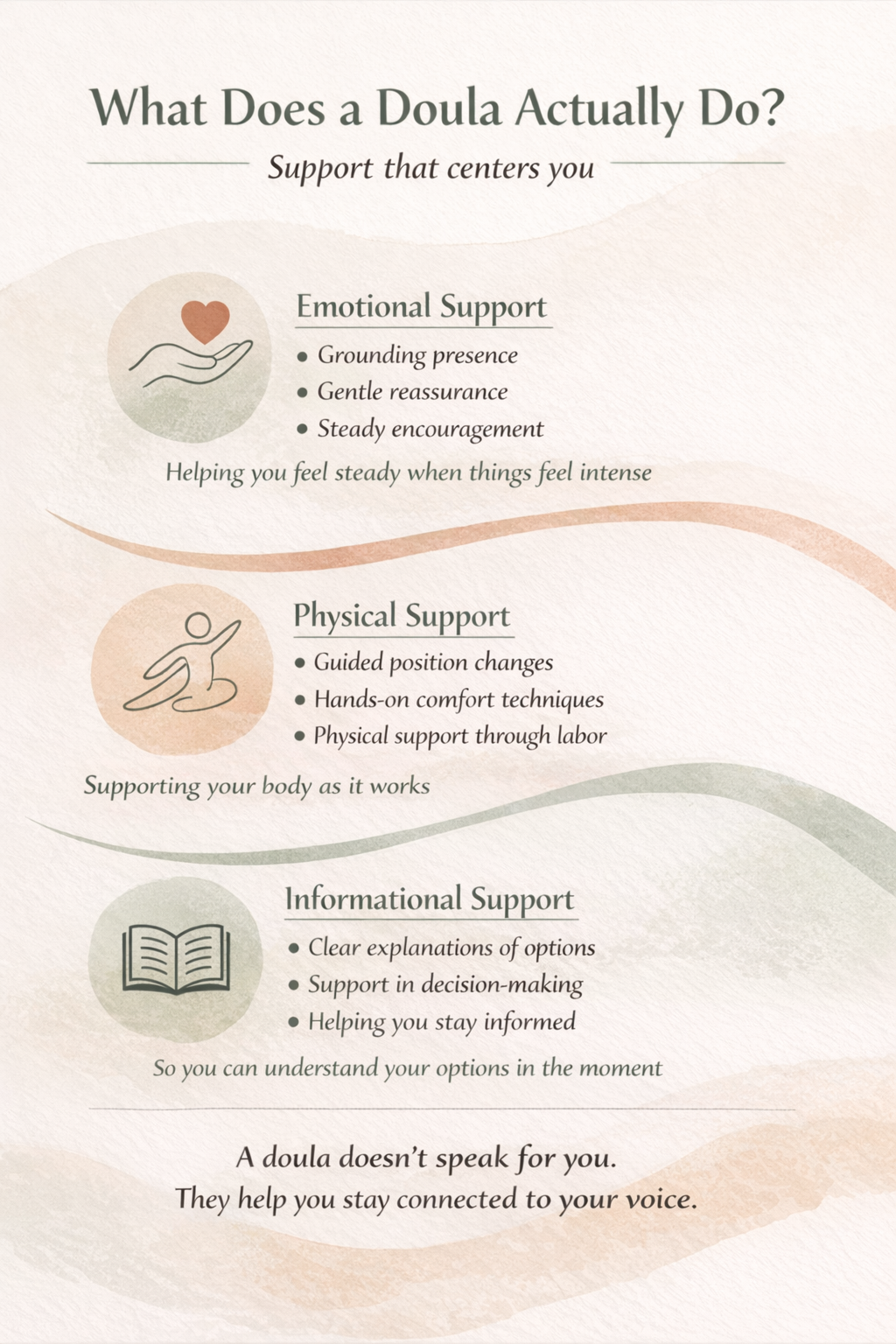
infographic outlining emotional, physical and informational doula support
While this breaks it down simply, doula support is often more nuanced than a checklist. It’s about attuning to your needs in real time; emotionally, physically, and mentally.
A doula supports you in your birth experience.
A doula may help you:
Move through different labor positions - opening the hips, using movement as pain management, helping labor to progress, and shifting baby into different positions.
Use breath and relaxation techniques - the most popular coping tools in the history of labor!
Stay nourished and hydrated - labor is a marathon, and you need fuel.
Navigate suggestions from your care team - what makes the most sense for YOU.
Support your partner so they can stay present and involved - your connection to your person is a powerful labor tool
A doula does not take over your birth. They help you stay connected to your body, your preferences, and your voice.
What does a doula do before and after birth?
Doula support often begins before labor and may continue after birth.
Before birth (prenatal visits):
Build trust and connection - face to face, rapport building
Explore your birth preferences - discuss your wishes and/or concerns for your birth experience
Prepare for different labor scenarios - even the best laid plans can go awry during labor, being prepared can bring peace
Discuss postpartum and feeding options - a skilled doula should be able to support breastfeeding, as well as bottle feeding and formula options
After birth (postpartum support):
Emotional support and processing - revisiting your birth story can bring clarity and understanding
Infant feeding guidance - the early days of feeding are crucial to baby’s development
Newborn care education - bathing, sleep, swaddles and diapers, we are here for it all
Support during recovery - your body is doing a lot of healing postpartum

Doula holding pregnant client’s hands
What a doula is not
A doula is not a medical provider.
They do not:
Perform medical procedures
Give medical diagnoses
Make decisions for you
Instead, they work alongside your medical team, focusing entirely on your experience.
A doula’s role is not to speak for you, but to amplify your voice, help you feel informed, and confident in your decisions.
Benefits of Having a Doula
The World Health Organization recommends continuous support during labor, and for good reason.
Research shows that having a doula may lead to:
Lower rates of cesarean birth - continuous support is associated with fewer surgical births and more spontaneous vaginal births
Shorter labor - steady presence, movement, and support can help labor progress more efficiently
Reduced need for interventions - including lower use of pain medication, forceps, and vacuum assistance
Less anxiety during labor - emotional reassurance and consistent presence can reduce fear and stress
Higher satisfaction with the birth experience - feeling informed, respected, and supported shapes how people remember their birth
Beyond the data, there is something harder to measure but just as important: With doula support many people feel more grounded. More confident. Less alone.
A doula doesn’t change the unpredictability of birth, but they can change how you move through it.
Source:https://pmc.ncbi.nlm.nih.gov/articles/PMC10292163/

Doula with supportive hands on client’s belly
Do I need a doula?
You may benefit from a doula if you:
Want continuous support during labor - doulas do not work in shifts, we are there as long as you need us
Feel unsure or overwhelmed about birth - a doula can provide you with reassurance, clarity and confidence
Want help understanding your options - evidence-based education is a big part of doula support
Desire a more grounded, supported experience - we curate the vibe of your birth space in real-time
Even with a supportive partner or medical team, a doula brings a unique role; someone whose sole focus is you.
How much does a doula cost?
Doula services typically range from $1,000 to $4,000, depending on experience, location, and services.
For many, this isn’t just about cost, it’s about the kind of support they want during one of the most significant experiences of their life.
Is a doula covered by insurance?
Some insurance plans reimburse part of the cost, but coverage varies.
Check directly with your provider for details.
How to Choose the Right Doula
Look for someone who makes you feel:
Comfortable - able to be yourself, ask questions, and take up space without hesitation
Safe - physically, emotionally, and mentally supported in your experience
Heard - your preferences, concerns, and intuition are listened to and respected
Supported - not directed, but steadied, informed, and encouraged
A doula is not just someone who shows up on the day of your birth. They are someone who holds space for you in one of the most vulnerable and powerful moments of your life.
This relationship matters. Trust your instincts. You deserve support that centers you.
Final Thoughts
Birth is an experience that stays with you.
It becomes part of your story; how you felt, how you were treated, how supported you were in the moments that mattered most.
Having someone whose role is to support your voice, your choices, and your experience can make a lasting impact. Not because they change the outcome, but because they help shape your experience of it.
A doula doesn’t take over your birth. They don’t speak for you. They don’t replace your intuition. They help you come back to yourself, to your breath, to your voice.
They remind you:
You are doing it.You are allowed to take up space here.You are allowed to ask questions, to pause, to choose.
Support in birth is about empowerment. It’s about feeling steady, informed, and seen within the experience you are having.
You deserve that.
If you're preparing for birth and looking for steady, personalized support, you can learn more about doula care here.
